

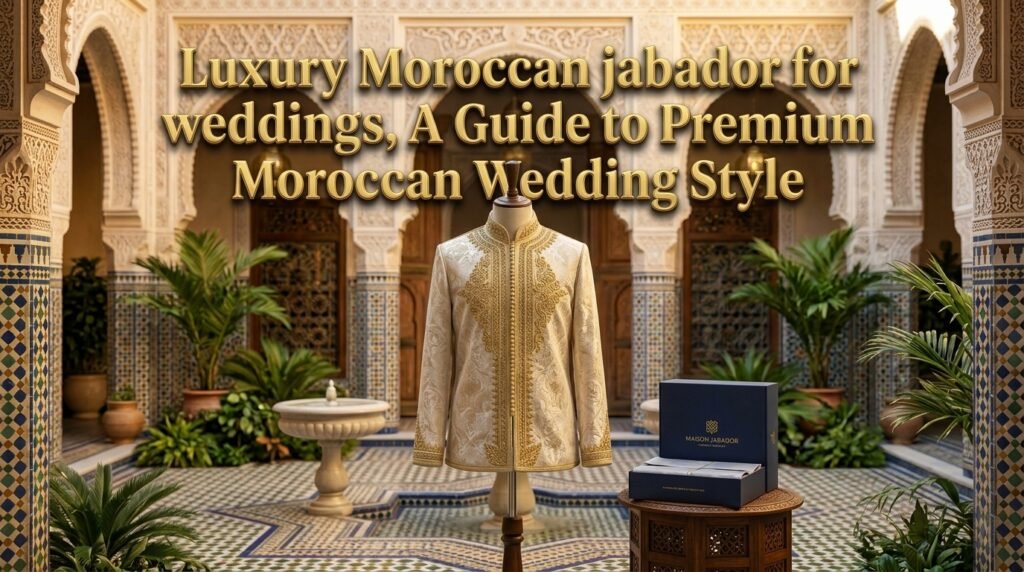
Luxury Moroccan jabador for weddings, Why the right outfit matters
A luxury Moroccan jabador for weddings combines traditional Moroccan style with refined fabric, embroidery, fit, and finishing. For a groom or wedding guest, the right jabador should look ceremonial while remaining comfortable enough for hours of celebration, photographs, and movement.
A Moroccan wedding outfit is rarely just another item of formalwear. It can become part of the visual memory of the entire celebration: the entrance, family photographs, dinner, dancing, and all those small moments that end up in an album years later.
That is why choosing a jabador deserves more attention than simply selecting the most decorated design you can find.
A well-made jabador brings together a recognizable Moroccan silhouette, coordinated trousers, carefully positioned embroidery, suitable fabric, and a comfortable fit. Traditional Moroccan clothing remains closely associated with celebrations and ceremonies, while contemporary designers continue adapting familiar garments for modern tastes.
You might prefer an ivory jabador with subtle gold embroidery, a deep navy design, an elegant three-piece outfit, or a more elaborate ceremonial style with metallic detailing.
The important point is this:
Luxury does not automatically mean more decoration.
A premium wedding jabador should feel balanced. Fabric, cut, embroidery, color, proportions, accessories, and finishing should support one another rather than compete for attention.
This guide explains what to look for, how to compare two-piece and three-piece designs, how to choose colors, how to order safely online, and how to coordinate a groom’s jabador with a bride’s Moroccan wedding outfit.
What is a luxury Moroccan jabador?
A luxury Moroccan jabador is an elevated form of traditional Moroccan attire, generally built around a tunic and trousers, with premium versions sometimes adding a vest or cape. Its quality comes from fabric, embroidery, construction, fit, and finishing—not simply from its price.
The jabador is traditionally associated with Moroccan men’s clothing. Its recognizable structure usually combines a decorated tunic with trousers, although contemporary collections offer different configurations, including two-piece and three-piece versions.
For weddings, the styling becomes more formal.
Typical jabador components
| Component | Purpose | What to examine |
|---|---|---|
| Tunic | Main visible garment | Cut, fabric and embroidery |
| Trousers | Completes the silhouette | Waist, length and comfort |
| Vest | Adds structure | Fit and detailing |
| Cape/Selham | Creates a ceremonial layer | Drape and finishing |
| Embroidery | Provides decorative detail | Symmetry and stitch quality |
| Babouches | Traditional footwear | Leather, construction and comfort |
Some current collections specifically market two-piece and three-piece jabadors for weddings and other formal occasions.
Jabador vs. Moroccan caftan
The jabador and caftan should not be treated as interchangeable terms.
The jabador is generally identified by its coordinated tunic-and-trouser structure. A Moroccan caftan, by contrast, is typically a longer ceremonial garment.
Both can appear at the same Moroccan wedding, but they serve different styling purposes.
For a groom or male guest who wants traditional Moroccan clothing without the longer silhouette of a caftan, a refined jabador can provide a strong formal alternative.
For brides, Moroccan caftans and takchitas remain particularly important ceremonial choices. That distinction becomes useful when creating coordinated outfits for a couple.
Why choose a premium jabador for a Moroccan wedding?
A premium jabador gives you the traditional character of Moroccan formalwear while allowing you to prioritize comfort, fit, craftsmanship, and ceremony-appropriate styling. The strongest wedding designs balance appearance with practical wearability instead of relying on decoration alone.
Moroccan weddings can last for hours and may include several stages of celebration. You may be standing for photographs, greeting relatives, moving between rooms, eating, dancing, or changing locations.
A garment that looks impressive in an online photograph but feels restrictive after an hour is not necessarily a good wedding purchase.
1. Fabric affects the entire look
Fabric influences:
- How the garment falls
- How embroidery appears
- How comfortable it feels
- How easily it wrinkles
- How formal it looks
- How it behaves under photography lighting
Contemporary Moroccan jabador collections use a variety of fabrics, including cotton, gabardine, velvet, crepe, and other formal fabrics.
For a summer wedding, a lighter construction can be easier to wear. For a winter or evening celebration, a heavier or richer fabric may create the formal appearance you want.
2. Embroidery should look deliberate
Premium embroidery is not simply a matter of having more thread or metallic decoration.
Look at:
- Collar alignment
- Sleeve detailing
- Chest motifs
- Cuffs
- Repeated patterns
- Thread consistency
- Symmetry
A well-designed jabador should look intentional from several feet away but still reward closer inspection.
3. Proportion matters
Online clothing photographs can hide fit problems.
Two garments labeled XL can have very different measurements.
Before ordering, compare the seller’s measurements with your own:
- Chest circumference
- Shoulder width
- Sleeve length
- Tunic length
- Trouser waist
- Trouser length
- Preferred fit
Your usual Western size should be treated as a starting point—not the final answer.
Luxury Moroccan jabador for weddings: 2-piece vs. 3-piece
A two-piece jabador creates a cleaner and lighter silhouette, while a three-piece design adds another layer and can produce a more formal appearance. Neither is automatically more luxurious; fabric quality, fit, embroidery, and construction matter more than the number of pieces.
Moroccan weddings and traditional clothing
| Style | Visual effect | Potential use |
|---|---|---|
| 2-piece | Clean and streamlined | Guests, engagements, warmer weddings |
| 3-piece | Layered and formal | Grooms, evening celebrations |
| Jabador + cape | Ceremonial and dramatic | Groom entrance and photographs |
| Embroidered tunic + trousers | Traditional and understated | Family celebrations |
A three-piece jabador may be an attractive choice when you want additional structure, but don’t assume that adding a vest automatically makes a garment premium.
A beautifully constructed two-piece outfit can look considerably more sophisticated than a poorly finished three-piece design.
Your event, season, personal style, and desired formality should determine the choice.
How to choose a luxury Moroccan jabador color
The right wedding jabador color depends on the ceremony, season, venue, personal preference, and coordination with your partner’s outfit. Ivory, cream, navy, black, royal blue, emerald, and burgundy can all create different formal effects when paired with appropriate embroidery.
Ivory and cream
Ivory and cream are natural choices when you want a refined ceremonial appearance. They can also create a softer visual effect in wedding photography.
Navy
Navy provides a sophisticated alternative to black and can work particularly well for evening celebrations.
Black
Black creates a strong formal foundation. Gold or silver embroidery can add contrast without requiring a complicated base color.
Royal blue
Royal blue can make the outfit more noticeable while allowing the overall design to remain relatively simple.
Emerald and deep green
Deep green provides another rich option for someone who wants color without choosing an extremely bright shade.
A simple color rule
If your embroidery is elaborate, consider keeping the base fabric relatively calm.
If the fabric is understated, stronger embroidery or accessories can provide the visual focal point.
This balance prevents the outfit from becoming unnecessarily busy.
Designer Moroccan jabador shopping: What should you inspect?
When shopping for a designer Moroccan jabador online, inspect more than the product photograph. Verify fabric composition, measurements, included pieces, construction, production location, shipping, returns, care instructions, and customization options before purchasing.
A polished photograph tells you what the seller wants you to see. Specifications tell you what you are actually buying.
Fabric questions
Ask:
- What is the fabric composition?
- Is it lightweight or heavy?
- Does it stretch?
- Is the embroidery handmade or machine-made?
- Is the garment lined?
- How should it be cleaned?
Construction questions
Check whether the seller explains:
- Seam finishing
- Embroidery placement
- Included trousers
- Included vest or cape
- Closures and buttons
- Lining and internal construction
Seller questions
Before paying, confirm:
- Where is the garment made?
- Where does it ship from?
- What is the expected delivery window?
- What happens if the size is incorrect?
- Is customization available?
- Is there a detailed size chart?
These questions become particularly important when ordering internationally.
Buy luxury Moroccan jabador online: A safer buying process
To buy a luxury Moroccan jabador online with less risk, start with your measurements rather than your normal size. Then verify the garment specifications, included pieces, delivery schedule, return policy, and seller communication before completing the purchase.
Step 1: Measure yourself
Wear a thin layer of clothing and record:
- Chest
- Waist
- Shoulders
- Arm length
- Height
- Trouser waist
- Inside leg
Write the numbers down rather than estimating.
Step 2: Compare the size chart
Match your measurements against the seller’s chart.
If you fall between two sizes, contact the seller before ordering. A short conversation can prevent an expensive exchange later.
Step 3: Confirm exactly what you receive
Never assume that the word “jabador” means the same package everywhere.
Confirm whether your order contains:
- Tunic
- Trousers
- Vest
- Cape
- Belt
- Accessories
Current listings can vary between two-piece wedding jabadors and three-piece designs, making this check particularly important.
Step 4: Plan delivery around the wedding
Give yourself time for:
- International shipping
- Customs processing where applicable
- Trying the outfit on
- Alterations
- Exchanges
- Unexpected delays
If the wedding date is fixed, ask the seller for a realistic delivery estimate before placing the order.
Custom luxury jabador for bride and groom
A custom luxury jabador can coordinate a couple’s wedding style through shared colors, embroidery, fabrics, or design details. The bride and groom do not need identical outfits; coordinated Moroccan garments can create a more natural and sophisticated result.
This distinction is important.
The groom can wear a luxury jabador while the bride chooses a caftan or takchita. The two outfits can still look deliberately connected.
| Groom | Bride | Coordinating detail |
|---|---|---|
| Ivory jabador + gold | Ivory/gold caftan | Gold embroidery |
| Navy jabador | Caftan with navy accents | Shared color |
| Emerald jabador | Emerald takchita | Green palette |
| Burgundy jabador | Burgundy caftan details | Matching accents |
| Cream jabador | Cream bridal caftan | Neutral palette |
This approach gives the couple a coordinated appearance without making the outfits look like uniforms.
Moroccan wedding traditions also vary by region and family, and celebrations may involve several garments and styling changes.
High-end wedding jabador for men and women: Understanding modern styling
The jabador has historically been associated primarily with Moroccan men’s clothing, while contemporary fashion can reinterpret traditional silhouettes for women. For a wedding couple, coordinating a groom’s jabador with a bride’s caftan or takchita is often more natural than treating the jabador as an identical outfit for both.
For the groom
Consider:
- A two-piece or three-piece jabador
- Ivory, cream, navy, black, or another suitable base
- Gold or silver embroidery
- Matching babouches
- Optional selham or cape
- Coordinated accessories
For the bride
Depending on personal style and the wedding ceremony, consider:
- Moroccan caftan
- Takchita
- Coordinated embroidery
- Matching jewelry tones
- A complementary rather than identical color
The goal is visual balance, not duplication.
If both outfits contain the same gold embroidery or share the same navy-and-cream palette, guests will immediately recognize the connection without the garments needing to look identical.
Traditional wedding outfits Morocco store: Building the complete look
A traditional wedding outfits Morocco store may offer more than a jabador. Depending on the retailer, you may also find babouches, capes, belts, caftans, djellabas, gandouras, accessories, and coordinated family outfits that help complete a Moroccan ceremonial wardrobe.
Think about the complete appearance before purchasing the main garment.
Wedding outfit checklist
- Luxury jabador
- Matching trousers
- Babouches
- Optional selham or cape
- Appropriate belt
- Watch or understated accessories
- Suitable socks
- Coordinated colors
- Garment bag
- Correct size
Accessories should support the outfit rather than compete with it.
A beautifully embroidered jabador can lose some of its visual impact if it is paired with footwear or accessories that clearly belong to a different style.
Moroccan traditional clothing remains connected to celebrations and ceremonies, while contemporary fashion continues to adapt traditional pieces.
What makes a jabador look expensive?
A jabador looks luxurious when its fabric, fit, embroidery, finishing, and styling are consistent. A higher price alone does not prove quality. Instead, examine the construction and specifications to understand what you are actually paying for.
The five-point luxury test
1. Fabric
Does the material suit the season, venue, and formality?
2. Fit
Do the shoulders sit correctly? Does the tunic fall naturally?
3. Embroidery
Are the motifs clean, balanced, and symmetrical?
4. Finishing
Are the seams, cuffs, collar, hems, and closures carefully completed?
5. Styling
Do the trousers, footwear, accessories, and colors work together?
If these five areas are strong, the garment is more likely to produce the polished appearance you are looking for.
Order premium Moroccan jabador online: Delivery and care
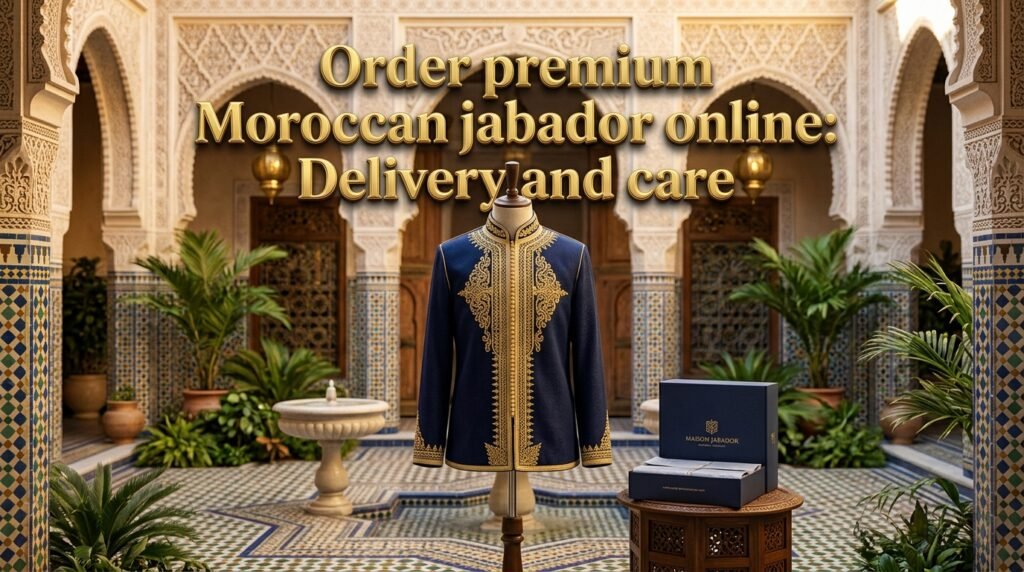
When you order a premium Moroccan jabador online, leave enough time for delivery, fitting, alterations, and possible exchanges. After receiving it, follow the manufacturer’s care instructions because embroidery and delicate fabrics may require gentler treatment.
Shipping and return policies vary between Moroccan clothing retailers, so check the actual terms attached to the garment you purchase. Product-specific care instructions should also take priority over generic clothing advice.
Before storing your jabador
- Make sure it is completely dry.
- Use an appropriate hanger.
- Avoid crushing embroidered areas.
- Keep it away from direct sunlight.
- Use a breathable garment bag where possible.
- Store accessories separately.
If the garment has substantial embroidery or delicate fabric, professional cleaning may be safer than experimenting with an unfamiliar washing method.
A practical luxury jabador buying framework
The easiest way to compare wedding jabadors is to evaluate occasion, fabric, fit, craftsmanship, color, comfort, delivery, returns, care, and customization. This keeps your purchase decision based on concrete information rather than photographs alone.
| Factor | Question to ask |
|---|---|
| Occasion | Is it formal enough for the ceremony? |
| Fabric | Does it suit the season? |
| Fit | Do the measurements match your body? |
| Craftsmanship | Is the embroidery clean and balanced? |
| Color | Does it work with the wedding palette? |
| Comfort | Can you wear it for several hours? |
| Delivery | Will it arrive early enough? |
| Returns | Can you exchange it if necessary? |
| Care | Can you maintain it correctly? |
| Customization | Can important details be adjusted? |
This framework is especially useful when comparing several products that look similar in photographs.
Instead of asking only, “Which one looks best?”, ask, “Which one gives me the strongest combination of quality, fit, suitability, and service?”
That question produces a much more useful comparison.
Expert note: Moroccan craftsmanship and cultural context
Moroccan traditional clothing has a broader cultural context than any single modern product listing. The jabador sits within a living tradition of Moroccan dress that continues to appear in celebrations while contemporary designers adapt familiar silhouettes and decorative techniques for modern wear.
That context matters when shopping internationally.
“Authentic Moroccan” should not mean that every modern garment must look exactly like a historical example. Traditional clothing changes over time, and contemporary Moroccan designers reinterpret established silhouettes, fabrics, embroidery, and proportions.
The more useful question is whether a modern garment respects the tradition it draws from while being well made for the person wearing it.
That means paying attention to craftsmanship, materials, construction, and cultural context rather than treating a label such as “Moroccan” as a substitute for quality.
Frequently Asked Questions About Luxury Moroccan Jabador for Weddings
What is a luxury Moroccan jabador for weddings?
A luxury Moroccan jabador for weddings is a refined ceremonial version of the traditional jabador, generally featuring a decorated tunic with matching trousers. Premium designs may add a vest or cape and place greater emphasis on fabric, embroidery, fit, and finishing.
Can I buy a luxury Moroccan jabador online?
Yes. Specialist Moroccan clothing retailers and independent sellers offer jabadors online. Before ordering, verify measurements, fabric, included pieces, production location, delivery time, returns, and customization options.
Is a jabador suitable for a Moroccan groom?
Yes. The jabador is an established option for Moroccan male formalwear, and contemporary wedding collections include both two-piece and three-piece styles intended for weddings, engagements, and other celebrations.
Can a bride wear a luxury Moroccan jabador?
A bride can choose a jabador-inspired outfit if it suits her personal style. However, Moroccan bridal wardrobes are strongly associated with caftans and takchitas. A groom’s jabador paired with a bride’s caftan or takchita is another natural way to coordinate the couple.
How do I choose the right jabador size online?
Use your actual measurements rather than relying only on your normal clothing size. Compare chest, shoulders, sleeves, tunic length, waist, and trouser measurements with the seller’s chart. If you fall between sizes, contact the seller before ordering.
What color jabador is best for a wedding?
There is no universally correct color. Ivory, cream, navy, black, emerald, burgundy, and royal blue can all work. Consider the wedding palette, season, venue, lighting, personal style, and the colors used in your partner’s outfit.
Final buying advice
A luxury Moroccan jabador for weddings should make you feel appropriately dressed without making you feel as though you are wearing a costume.
That balance matters.
You want tradition, but you also want comfort.
You want embroidery, but you do not necessarily need decoration covering every visible surface.
You want a luxurious appearance, but you should be able to identify what creates that value: better fabric, careful craftsmanship, precise construction, good fit, refined finishing, or meaningful customization.
When you buy luxury Moroccan jabador online, begin with measurements and specifications. Then investigate the fabric. Examine the embroidery. Confirm every piece included in the package. Read the delivery and return conditions. Finally, consider how the jabador will work with your shoes, accessories, venue, and your partner’s outfit.
For a groom, a three-piece jabador can create a particularly formal appearance, while a refined two-piece design may offer greater simplicity and versatility. For a wedding guest, a less elaborate design may be appropriate. For a couple, matching colors or embroidery can create visual harmony without requiring identical outfits.
Most importantly, give yourself enough time.
A wedding outfit should not arrive shortly before the ceremony with no opportunity to test the fit, request an exchange, or make alterations.
If you are searching for a custom luxury jabador for bride and groom, start by choosing one shared visual element—perhaps ivory and gold, navy and silver, emerald and gold, or another palette that fits the celebration. Then build each person’s outfit around that theme.
That is how you create a coordinated Moroccan wedding look that feels personal rather than copied.
And when the wedding day arrives, the simplest sign that you made the right choice is that you can move comfortably, stand confidently, enjoy your guests, and forget about your clothes for a while.