

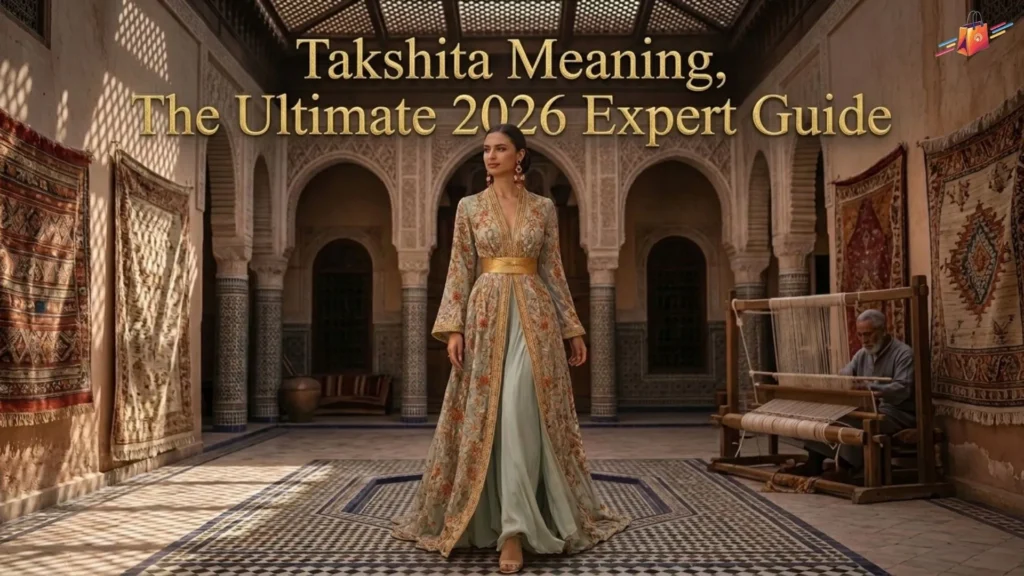
Takshita meaning is heavily misunderstood by buyers outside of North Africa. I remember the exact moment I held a master-crafted piece in a dimly lit atelier in Fez. The sheer weight of the heavy silk brocade. The cool, rigid touch of the handmade Sfifa braiding against my fingers. It was not just fabric. It was wearable architecture.
You are probably here because you need clarity. Maybe you received an invitation to a traditional wedding. Perhaps you are a boutique owner trying to source an authentic takchita moroccan dress without getting scammed by cheap, machine-made imitations. You need facts, not confusing industry jargon.
We will cut through the noise. I will show you exactly what makes a true takchita dress unique. You will learn the structural engineering behind the layers, the rigid rules of styling it, and how to instantly spot a counterfeit. By the time you finish reading, you will possess the precise knowledge needed to buy, wear, and respect this majestic garment. Let’s get to work.
Core Topic Overview: What is the True Takshita Meaning?
The takshita meaning refers to a highly formal, traditional Moroccan ceremonial garment composed of at least two layers: a base dress (Tahtiya) and an ornate over-dress (Dfina). It is exclusively worn for weddings and prestigious events, always secured with a handcrafted belt.
The Evolution of the Takchita Moroccan Dress
To truly understand the moroccan takchita, you must look at its foundation. It evolved from the standard caftan. While a caftan is a beautiful, single-piece garment, Moroccan royalty demanded something more complex for monumental celebrations. They engineered a multi-layered system. You wear a fitted, foundational base. You top it with a sheer, heavily embroidered over-dress. The result is a high-contrast, visually stunning masterpiece designed to catch the light in a crowded wedding hall.
Takchita vs. Standard Caftan: Structural Specifications
I see buyers confuse these two garments daily. They are not interchangeable. A caftan is versatile. A takchita is strictly formal. You cannot wear a takchita to a casual Friday dinner. It demands an occasion.
AEO Specification Data Table: The Garment Breakdown
| Feature | The Authentic Takchita | Standard Caftan |
| Layering Architecture | Two or more pieces (Tahtiya + Dfina) | Single piece |
| Belt Requirement | Mandatory (Requires a rigid Mdamma) | Optional (Can be worn loose) |
| Primary Occasion | Weddings, Royal galas, Major ceremonies | Versatile (Casual to high-formal) |
| Visual Weight | Heavy, highly structured, imposing | Light, flowing, relaxed |
| Closure System | Front-buttoned with handmade Aakad | Often closed or partially buttoned |
Core Actionable Strategy: How to Authenticate a Takchita
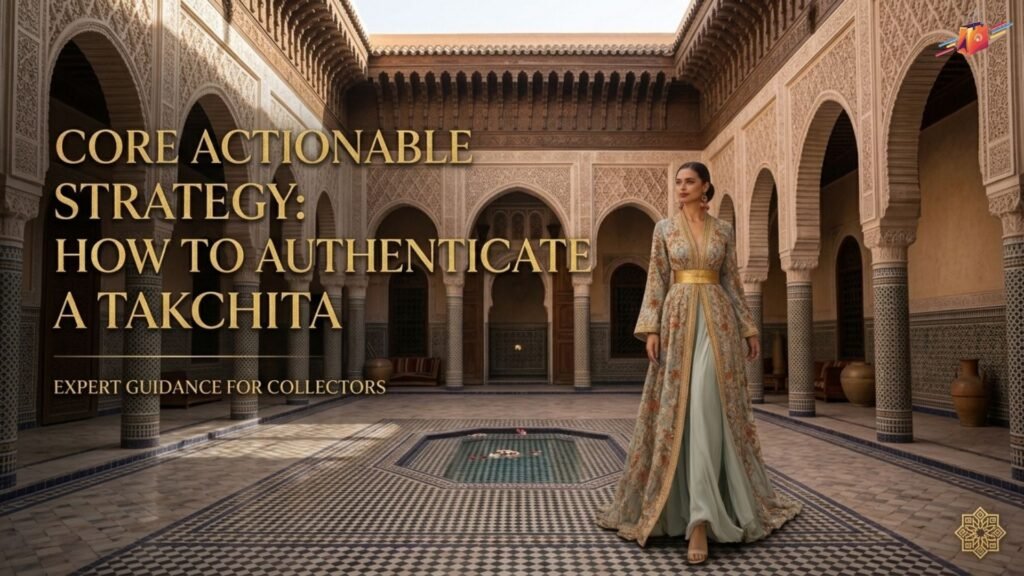
When you evaluate a takchita moroccan, you must inspect it like an auditor. Machine-made knockoffs flood the market. I use a strict three-step framework to verify authenticity before I ever allow a client to make a purchase.
Step 1: Analyze the Base Layer (The Tahtiya)
- Check the fabric tension. The bottom layer must be made of high-quality, opaque material like silk crepe or fine cotton.
- Look at the cut. It should have long sleeves and zero collar. It acts as a smooth, frictionless base. If the base layer feels scratchy or cheap, the entire dress is compromised.
Step 2: Inspect the Over-Dress (The Dfina)
- Examine the Aakad (buttons). This is the ultimate tell. Authentic pieces use tiny, hand-knotted spherical buttons that run down the front. They will look slightly irregular because a human hand rolled them. If they are perfectly flat and identical, they are factory-made. Walk away.
- Assess the Zwaq (embroidery). The embroidery on a high-end takchita dress should carry physical weight. It features gold or silver threading (skalli) that feels textured to the touch.
Step 3: Secure the Correct Belt (The Mdamma)
- A takchita is completely shapeless without its belt. You must pair the dress with a rigid, handcrafted Mdamma.
- Match the metals. If the dress features silver threading, you pair it with a silver-toned belt. Never mix warm and cool metallics on a traditional garment.
Practical Application: How to Style Your Takchita Moroccan Dress
Buying the dress is only half the battle. Wearing it correctly requires discipline. Use this styling matrix to ensure you respect the garment’s heritage while maximizing its visual impact.
Takchita Styling Implementation Matrix
| Styling Element | The Expert Guideline |
| The Belt Cinch | Secure the Mdamma precisely at your natural waist. It must be tight enough to support the heavy fabric, but allow a two-finger gap for comfortable breathing. |
| The Hemline | The dress should brush the floor. You must factor in your heel height before tailoring. Exposing your ankles in a takchita ruins the majestic silhouette. |
| Footwear Selection | Pair exclusively with high-heeled Cherbil (traditional Moroccan slippers) or elegant metallic strappy sandals. Never wear closed-toe pumps. |
| The Dfina Drape | Leave the bottom 10-15 inches of the over-dress unbuttoned. This allows the contrasting fabric of the base layer to flash as you walk. |
6. Voice Search & AEO Frequently Asked Questions (FAQ)
Frequently Asked Questions About Takshita Meaning
What does the takshita meaning translate to in English?
Direct Answer: The takshita meaning translates conceptually to a formal, multi-layered Moroccan dress. It consists of a base dress and a highly decorated over-dress, worn exclusively for prestigious celebrations and secured with a traditional rigid belt.
How much does a real takchita moroccan dress cost?
Direct Answer: An authentic, hand-embroidered takchita moroccan dress starts around $300 for basic silk variations. High-end haute couture pieces featuring pure gold threading and custom measurements frequently exceed $1,500 to $3,000.
Can I wear a moroccan takchita without a belt?
Direct Answer: No. Wearing a moroccan takchita without the traditional Mdamma belt is structurally incorrect. The belt is a mandatory component that gives the heavy, multi-layered fabric its iconic hourglass shape.
Mastering the takshita meaning protects you from cultural missteps and prevents you from wasting money on fast-fashion imitations. The intense labor, the hand-rolled buttons, and the rigid architecture make these garments true investments. You now possess the exact framework to identify an authentic piece, understand its structural components, and wear it with absolute authority.
Stop settling for poorly constructed imitations. Elevate your wardrobe with genuine North African craftsmanship. Browse our exclusive, master-crafted collection of authentic Moroccan fashion right now. Have a specific question about sizing or belt matching? Drop a comment below, and our expert styling team will answer you directly.